

It seems like forever ago that Kelly Quinn spoke at (to? with?) the Davies Forum. But I just made a vow to finally finish blogging all of our speakers (it is kinda required) in chronological order, and Kelly is where I left off.
Kelly was an awesome speaker. Her presentation style, content, and overall message were amazing. Some of the highlights:
-A grid is the most democratic way to lay out a city because it allows anybody to find his/her way without asking for directions. In a conversation the next morning, Kelly mentioned to me that some feminists argue that a circle is the most democratic, for what reason I do not remember. "I bet it's psychoanalytic feminists who say that," I responded, as if the term is a slur. "You bet." Damn you, psychoanalytic feminists!
-"Homogeneity is important to a lot of people... It's important to 92% of the people in my town." (on the homogeneity and the white population of her town)
-More than being democratic, the grid also allows for an element of surprise in the city. You turn a corner, and suddenly you bump into a neighbor, or a garage sale, or a flier for a lost kitten. Or, in Kelly's world, it would be nice to bump into a bit of history about your neighborhood, possibly printed on the back of a paper fan.
-"I like saying the word intercourse in public" (on social intercourse)
-Kelly met with some of the Davies students Friday morning, and she and I took a short walk around around the USF neighborhood. During the course of the stroll, Kelly stopped next to a box that holds plastic baggies for dog poo. The university erects the boxes in the hope that dog owners will clean up after their pets. Kelly pointed out how something such as the "doggie pot" can show what we value in our society - in this case, dogs, but not poo.
Thank you so much for speaking to (at? with?) us, Kelly!

Tag Cloud v.2
One of the tag cloud websites, TagCrowd, was down for some reason last night, but it is now up and running. Thus, here is a different tag cloud for the same project discussed previously. Also, the problem with tagging phrases (see comments for the previous post) has been fixed by combining all words in the phrase into one word, which results in some interesting looking tags that I promise are not typos.
acceptance activism affirmation animals anxiety assimilation awayfromcivilization balance beauty blake bugs cellphoneanxiety chainsaw change childhood choices city classmates cold collaboration comfort communalliving community compromise connected connections contacts countryliving daviesforum dirtroad disconnected documenting dogs driving ducklings earlymorning earth eggs environment environmental escape ethos expectations experience farm fire firewood firsts fleeting food forecast francis fulfilling fun garden gas goats habits hail happy harmony heat homesteading homework honesty humboldt icicle incorporation individual informative innerpeace instinct interconnected journal jovial joy learning lettinggo lifestyle loggingoff logs longdrive meals melindastone memory method mindful nature necessity newexperience noise non-digital notice npr octagon offthegrid online organic outside peace pedagogy perfect photography poem preparation prospective pure rational reconcile reflection relaxation renewableresources reporting resonate rhythm roadtrip rules rural savor sawing seasons self-reflection self-sufficient service silence simple simpleliving slow snoring snow snowball snowflake solarenergy solitude sound stonelake strangers struggle sunset sustainability sustenance swing teaching technology temporal temporary thegrid tick togetherness tools travel urban walks warmth waterfall weather wildness
created at TagCrowd.com
Tag Cloud
In class today, the Davies crew explored what it would be like to tag each other's blog posts (specifically, our "Best Blog Post Ever" assignment). We collectively tagged everybody's posts (except Steve, who is still working on his), and we came up with a list of 161 different tags.
I snapped a few pictures of the board, transfered all the data to a spreadsheet, and then created a paragraph of what our tags would look like. Since it takes almost an entire page, I won't post it here.
But I did found a sweet service that will create a tag could from any text you upload. Thus, you can find out collective tag cloud at Many Eyes. Enjoy!
I snapped a few pictures of the board, transfered all the data to a spreadsheet, and then created a paragraph of what our tags would look like. Since it takes almost an entire page, I won't post it here.
But I did found a sweet service that will create a tag could from any text you upload. Thus, you can find out collective tag cloud at Many Eyes. Enjoy!
StoneLake Farm
The Davies Forum event for this weekend was a trip to StoneLake Farm in Humboldt county. The farm was beautiful, the company was jovial, the food was tasty, and the weather was...
Well, it snowed. Some people might complain about the snow, and the cold, but I loved it. I grew up in the Sacramento Valley and it never snowed there. The few times I have been to Truckee there has been snow on the ground, but no snow falling from the sky. So let's just say I was a tad out of my element (heh), and I loved every minute of it.
More importantly, with my first snow came my first sighting of a snowflake. I'm not talking a little frozen droplet of water, nor a little ball of snow falling from the sky, but an actual flake. Like the ones you draw in kindergarten, with six points and lacy stuff in between. The biggest shock to me? Oh my god was it tiny! And perfect! And the tininess made it that much more perfect!
I immediately grabbed for my camera to snag a picture (macro photography is my fav genre), but realized that I had left it in the Octagon. I asked Blake if I could borrow his (the Davies crew always has at least one camera on hand), but before he could hand it to me the perfect snowflake melted into the dirt. It disappeared back into the earth, and though I did snag a shot of a less-perfect cousin, the only person who will ever see that perfect snowflake is me. I can talk about it at length, but I have no proof that it ever existed except my own memory of the incident.
And you know what? That's OK.
Well, it snowed. Some people might complain about the snow, and the cold, but I loved it. I grew up in the Sacramento Valley and it never snowed there. The few times I have been to Truckee there has been snow on the ground, but no snow falling from the sky. So let's just say I was a tad out of my element (heh), and I loved every minute of it.
More importantly, with my first snow came my first sighting of a snowflake. I'm not talking a little frozen droplet of water, nor a little ball of snow falling from the sky, but an actual flake. Like the ones you draw in kindergarten, with six points and lacy stuff in between. The biggest shock to me? Oh my god was it tiny! And perfect! And the tininess made it that much more perfect!
I immediately grabbed for my camera to snag a picture (macro photography is my fav genre), but realized that I had left it in the Octagon. I asked Blake if I could borrow his (the Davies crew always has at least one camera on hand), but before he could hand it to me the perfect snowflake melted into the dirt. It disappeared back into the earth, and though I did snag a shot of a less-perfect cousin, the only person who will ever see that perfect snowflake is me. I can talk about it at length, but I have no proof that it ever existed except my own memory of the incident.
And you know what? That's OK.
Government Control of Information = Really, Really Bad
This, among other reasons, is why I am leery of the government owning knowledge or the access to knowledge.
Jane Jacobs and San Francisco
As part of the Davies Forum, I recently read some chapters from The Death and Life of Great American Cities. They were pretty interesting, and some of the ideas were counter to what one might think is common-sense urban planning. for example, Jacobs argues that having a bar on your street is beneficial because it provides a draw for more people to be on your street throughout the night. Why do you want people on your street? Eyeballs. For Jacbos, eyeballs (the more the merrier) are key to reducing crime in a neighborhood. The more people there are on the street, the less likely it is that crime will occur.
Because of the eyeballs issue, Jacobs also advocates for mixed-use spaces, such as apartments above businesses. In addition to offering their eyeballs, shopkeepers also act as trusted strangers for the block. Being a trusted stranger is an important distinction because the trust is built upon the fact that the individual has no interest to meddle in your personal life because he/she does not know about your personal life. In fact, on Jacobs' block it was common to leave a spare set of keys with the nearest shopkeeper because there was no reason the shopkeepers would ever want to use one's keys.
Overall, Jacobs thinks that the more people there are on a block, the more privacy you have. I agree with her mostly, but there is a certain lack of privacy with your immediate neighbors. For example, I know that my upstairs neighbors are having a somewhat rocky time in their relationship because I can hear them yelling at each other quite frequently. Zeph used to live below a couple who routinely had the loudest sex ever in at 3 in the morning. I have more privacy then I would if I lived in a town of 50 people, but I also wonder what my neighbors know about me based on what they can hear through my walls.
* * * * * * * Our assignment for the week was to choose a neighborhood in San Francisco that would make Jane Jacobs happy. I chose the few blocks surrounding the intersection of 9th Avenue and Irving Street.
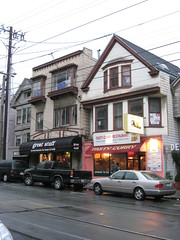
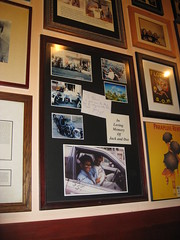

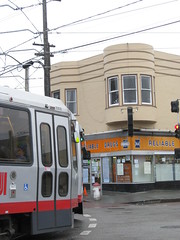
The shopkeepers that run the stores are also very kind to residents of the neighborhood. One of them let my friend Christina use his bathroom a few times when her toilet broke, and one of the pics above shows an homage to a customer in the local pizza shop.
There are also benches along the sidewalk, which encourage individuals to sit and converse with each other in public. Holding a conversation in a public space, according to Jacobs, is preferable to a private space because there is no intrusion into one's home. Joe Schmo and I can go get a beer at the Mucky Duck without him seeing my pantyhose drying in the bathroom (which I don't have, BTW).
Overall, 9th and Irving is a great spot in the middle of the Inner Sunset, and I think that Jane Jacobs would be happy to live there.
Because of the eyeballs issue, Jacobs also advocates for mixed-use spaces, such as apartments above businesses. In addition to offering their eyeballs, shopkeepers also act as trusted strangers for the block. Being a trusted stranger is an important distinction because the trust is built upon the fact that the individual has no interest to meddle in your personal life because he/she does not know about your personal life. In fact, on Jacobs' block it was common to leave a spare set of keys with the nearest shopkeeper because there was no reason the shopkeepers would ever want to use one's keys.
Overall, Jacobs thinks that the more people there are on a block, the more privacy you have. I agree with her mostly, but there is a certain lack of privacy with your immediate neighbors. For example, I know that my upstairs neighbors are having a somewhat rocky time in their relationship because I can hear them yelling at each other quite frequently. Zeph used to live below a couple who routinely had the loudest sex ever in at 3 in the morning. I have more privacy then I would if I lived in a town of 50 people, but I also wonder what my neighbors know about me based on what they can hear through my walls.
The shopkeepers that run the stores are also very kind to residents of the neighborhood. One of them let my friend Christina use his bathroom a few times when her toilet broke, and one of the pics above shows an homage to a customer in the local pizza shop.
There are also benches along the sidewalk, which encourage individuals to sit and converse with each other in public. Holding a conversation in a public space, according to Jacobs, is preferable to a private space because there is no intrusion into one's home. Joe Schmo and I can go get a beer at the Mucky Duck without him seeing my pantyhose drying in the bathroom (which I don't have, BTW).
Overall, 9th and Irving is a great spot in the middle of the Inner Sunset, and I think that Jane Jacobs would be happy to live there.
Fred Stutzman
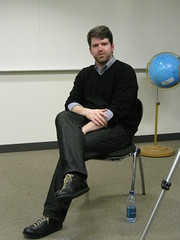
Fred Stutzman was the most recent speaker in the Davies Forum series. He actually gave his talk two weeks ago, but what with spring break and all this post was delayed.
Overall, I think Fred's talk was very informative. I can definitely tell that he is from a world of academics where all anybody is interested in is what literature you draw on to support your findings and what statistical data you have to prove your conclusions. Ok, so not all academics function that way, but the ones that I find rather boring do. Unfortunately, Fred appears to be in that school, and as such parts of his talk were rather bland.
Not one to offer criticism without simultaneously giving suggestions, here is what I would do differently, Fred. Leave most of the theory out, or work it into your research without explaining it in-depth. I want to hear about Facebook and all of the interesting things you are finding, not about some guy's theory from the 1970s. Also, make your findings more prominent in the presentation. Your theories about why people got so riled up about the Facebook feeds is fascinating, and I would love to hear more about things like that, especially since, as a student, I don't need you to prove to me that it did happpen. These suggestions may apply only to undergraduate audiences, which as a Facebook researcher I am hoping you will encounter more and more.
My favorite part of the talk was the Q&A. Fred seemed a lot more relaxed, and there was less "here's what supports my argument" and more "here's my argument!" (if that makes sense to anybody but me).
As for the content of the presentation, what I found most interesting is that people assume that their profiles are only semi-public, even in terms of viewing by their "friends", who by default get to look at the entire profile. This makes me wonder if people feel the same about their blogs; even though they can be viewed by a large audience, most people assume only a very small subset of the Internet is actually reading.
Basically, Fred, you rock(!) for studying Facebook, and I wish your presentation rocked(!) as much as you do.
Co-Authored Paper
My friend Cassidy and I are trying to convince our U.S. Inequalities professor to let us co-author our research paper for the course. We want to compare and contrast how pro-anorexia and fat-acceptance blogs/websites reframe medical discourse. Should be interesting, right? Come on, Nikki, you know you want to let us do it, if only so you can read the paper. :-)
I'll keep everybody updated on the progress of the project.
I'll keep everybody updated on the progress of the project.
Bill to Make Anonymous Posting Illegal
A Kentucky lawmaker want to make anonymous internet posting illegal. From the article:
In addition, I wonder what would happen to the traffic on blogs that critique the current administration were such a law to come into effect. We have already seen what happens when you bash Bush on your MySpace page: you get visited by the U.S. Secret Service.
Not to mention the fact that such a law would cost so much money to enforce that the U.S. government might have to take some money from the military spending budget in order to finance it. Hmmm, maybe this is a good bill...
"The bill would require anyone who contributes to a website to register their real name, address and e-mail address with that site."Apparently the current argument against the bill (or at least the only one mentioned in the article) is that it violates first amendment rights. My critique is that it inhibits rights to privacy, which should extend to the right to have an online persona that is distinct from and not connected to an offline persona. I know plenty a blogger who only continues to blog because she can do so anonymously. This is especially important when it comes to individuals who blog about controversial issues, such as fledgling civil rights movements.
In addition, I wonder what would happen to the traffic on blogs that critique the current administration were such a law to come into effect. We have already seen what happens when you bash Bush on your MySpace page: you get visited by the U.S. Secret Service.
Not to mention the fact that such a law would cost so much money to enforce that the U.S. government might have to take some money from the military spending budget in order to finance it. Hmmm, maybe this is a good bill...
Delicious Meal
Those looking for my delicious meal post should head on over to my cooking blog, Sara's Scullery, for complete details on how to make yummy pasta sauce.
Ok, you have to look at the flickr set for complete details, but wouldn't it be fun to try making it just from looking at the images?
P.S. Has anybody noticed that my favorite literary device is alliteration?
ETA: Obtainment! Part of the assignment was to blog about the obtainment of the meal! Well, all the wonderful veggies as well as the olive oil came from Westside Organics (which I ramble on about here), and the tomato sauce and wine came from Trader Joe's. BTW, I love being in a class where the assignments usually begin with "blog about..."
Second edit: Edited a second time to fix some egregious typos. Apparently when I get excited I lose the ability to type!
Ok, you have to look at the flickr set for complete details, but wouldn't it be fun to try making it just from looking at the images?
P.S. Has anybody noticed that my favorite literary device is alliteration?
ETA: Obtainment! Part of the assignment was to blog about the obtainment of the meal! Well, all the wonderful veggies as well as the olive oil came from Westside Organics (which I ramble on about here), and the tomato sauce and wine came from Trader Joe's. BTW, I love being in a class where the assignments usually begin with "blog about..."
Second edit: Edited a second time to fix some egregious typos. Apparently when I get excited I lose the ability to type!